
Charlotte has grown fast, and so has the amount of floor that needs care every week. Office towers in Uptown, mixed use buildings in South End, medical offices along the outer loop, warehouses near the airport and hundreds of school buildings across Mecklenburg County all share the same problem: hard floors and carpet take a beating from local dirt and weather, and they lose their look faster than most managers expect.
This guide explains what actually wears down floors in the Charlotte area, what a professional floor care plan looks like, how often each step should happen and how to schedule the work so it never gets in the way of your business. It is written for facility managers, property managers, school staff and owners of shops and offices who want floors that look cared for without guessing.
What Charlotte weather and soil do to commercial floors
The biggest enemy of floors in the Piedmont is grit. Charlotte sits on red clay, and that clay dries into a fine, abrasive dust that rides in on every shoe. On vinyl composition tile (VCT), that grit acts like sandpaper. It scratches the protective finish, dulls the shine and eventually reaches the tile itself. On carpet, the clay leaves an orange tint in walkways that regular vacuuming cannot pull out.
Spring adds a second layer. From roughly March through April, pine and oak pollen coats parking lots, sidewalks and entrances in yellow. Pollen is sticky when humidity is high, so it smears on finished floors and gets ground into carpet fibers near doors. Then summer brings long, humid stretches and sudden afternoon storms, which means wet shoes, muddy mats and moisture that softens floor finish if it sits too long.
Winter in Charlotte is usually mild, but a few ice events each season bring sand and treatment products onto walkways. Those residues leave a white haze on finished floors if they are not removed quickly.
The building types that need the most attention
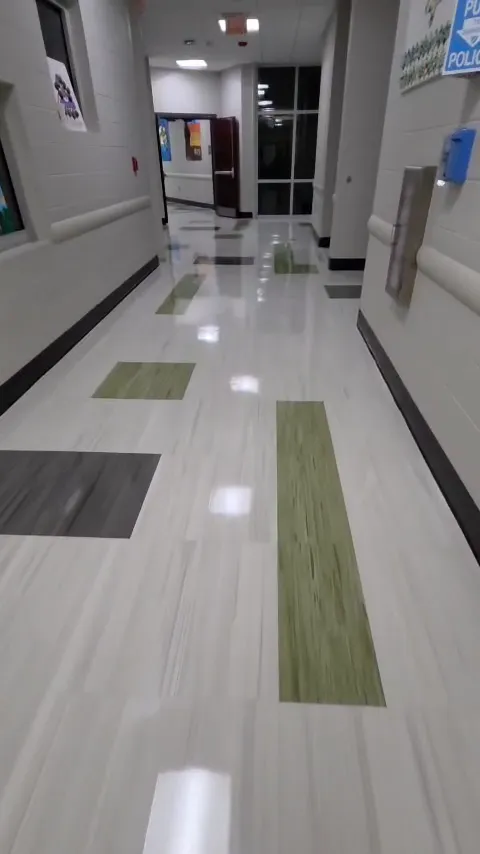
Schools are at the top of the list. Hallways and cafeterias in many Charlotte area schools use VCT because it is durable and affordable, but it only stays durable when the finish on top is maintained. A hallway that sees hundreds of students a day can lose its gloss in weeks if it is only mopped.
Offices and medical buildings come next. Lobbies, elevator landings and break rooms show wear first, and these are the spaces visitors judge your business by. Retail and restaurants deal with grease, spills and constant foot traffic near the register. Warehouses and light industrial spaces in the airport and University City areas often have sealed concrete or VCT in office sections that need a regular scrub and recoat.
Daily, periodic and restorative floor care explained
A good floor program has three levels. Daily care is dust mopping or vacuuming, spot cleaning and damp mopping with a neutral cleaner. The goal is simple: get the grit off before it scratches. Walk off mats at every entrance do a lot of this work for free, as long as they are cleaned and replaced when full.
Periodic care keeps the finish healthy. On VCT this usually means burnishing with a high speed machine to bring the shine back, and every so often a scrub and recoat, where the top layers of finish are scrubbed lightly and new coats are applied. On carpet, periodic care means hot water extraction in traffic lanes and entrances.
Restorative care is the full strip and wax. The old finish is chemically removed down to the bare tile, the floor is rinsed and neutralized, and several fresh coats of finish are applied and then burnished. This is the step that makes an old hallway look new again, and it is usually done once or twice a year depending on traffic.
How often Charlotte buildings typically need each service
Every building is different, so treat these as starting points. Busy school hallways and cafeterias often need a full strip and wax once a year, usually in summer, plus burnishing every week or two during the school year. Office lobbies and corridors with moderate traffic often do well with a scrub and recoat two to four times a year and a full strip every one to two years.
Carpet in entrances and main walkways usually needs extraction every three to six months, and more often after pollen season or a wet winter. Retail floors and restaurant dining areas tend to need more frequent attention because of spills and constant traffic. A walk through of the space is the best way to set a real schedule.
Scheduling around school calendars and business hours
In North Carolina, most traditional calendar schools are on summer break from mid June to late August, and that window is when the heavy strip and wax work in hallways, cafeterias and gyms gets done. Winter break and spring break are good windows for smaller areas and touch ups. Year round schools have shorter breaks, so the work is planned track by track.
For offices and shops, the work is usually done after hours or over a weekend so floors have time to dry and cure. Deep Cleaning High Quality works 24 hours Monday through Friday and 8am to 5pm on weekends, which makes overnight floor work possible without closing your doors during the day.
What a strip and wax job looks like from start to finish
First the area is cleared and blocked off. Then a stripping solution is applied and worked in with a floor machine to break down the old finish. The slurry is picked up, and the floor is rinsed until no residue is left, because leftover stripper keeps new finish from bonding. After the floor dries, several thin coats of finish are applied with drying time between each. Once cured, the floor is burnished for the deep, wet look.
Our crew uses its own floor machines, burnishers, auto scrubber and extraction equipment, which means bigger jobs like school corridors and long office hallways can be handled by one team on a tight schedule.
What it typically costs in the Charlotte area
Pricing depends on square footage, the condition of the existing finish, how many coats are needed, furniture moving and access hours. Across the market, many companies quote strip and wax by the square foot, often somewhere in the range of a few tenths of a dollar per square foot, with burnishing and scrub and recoat costing less. Very small areas usually have a minimum charge. The only way to know your number is to have the floor looked at, which is why we offer a free estimate with no visit fee.
Common questions
01When is the best time to strip and wax school floors in Charlotte?
Summer break is the main window for traditional calendar schools, usually from mid June to late August. Winter and spring breaks work well for smaller areas or touch ups.
02Can floor care be done overnight so my business stays open?
Yes. Deep Cleaning High Quality works 24 hours Monday through Friday, so floors can be stripped, waxed or burnished overnight and be ready by morning.
03Why do my floors lose their shine so fast?
In the Charlotte area it is usually grit from red clay and pollen being walked across the finish. Better entrance mats, daily dust mopping and regular burnishing slow it down a lot.